Showing posts with label Hyundai. Show all posts

Wednesday, June 1, 2011

Toyota Sales Plunge More than 33% in May, Chrysler Group up by 10%


The numbers for U.S. auto sales for the month of May are out and as expected, Japanese automakers continue to be hit hard by the ongoing production disruptions caused by the March 11 earthquake, tsunami and nuclear disaster in their home market. As a result, Toyota’s sales plunged 33.4% over the year-ago month to 108,387 units, while rivaling Honda saw its sales fall 22.5% to 90,773 vehicles, Nissan recorded a 9.1% drop to 76,148 units and Mazda 17,875 vehicles, down 20.9%.

General Motors dealers in the United States delivered 221,192 vehicles in May posting a decline of 1%, while the Ford Motor Co. said its sales decreased by 0.1% to 192,253 cars, trucks and SUVs.

Read more »

Hyundai Reaches 5 Million Sales in Europe


South Korean carmaker Hyundai announced it has sold five million vehicles in Europe since the first Hyundai Pony was imported in 1977. The five millionth vehicle was an i30, which was launched in 2007 and has sold a little over 320,000 units on the continent. From the five million sales, the last million was achieved in just three years, a proof of Hyundai's accelerated growth in Europe. Read more »

All-New Hyundai i40 Tourer Priced from £18,395 OTR in the UK


Hyundai has priced its entry into the medium family estate car market, the new i40 Tourer, announcing that it will take from £18,395 (equal to US$30,340 or €21,100) for UK buyers to park one under their house. In comparison, the Ford Mondeo Estate starts from £18,955 for the 1.6i 120HP model, while the Vauxhall Insignia Sports Tourer from £19,350 with the 1.8-liter engine.

The estate version of the i40 will arrive in British showrooms this September followed shortly after by the sedan model, which was unveiled at the Barcelona International Motor Show in May.

Read more »

Thursday, May 26, 2011

Hyundai Prices Refreshed 2012 Genesis Sedan, 429HP 5.0 R-Spec Model Starts from $47,350


We had our first motor show look at the facelifted 2012 Hyundai Genesis sedan earlier this winter in Chicago, but now, as it reaches dealers across the country, the South Korean automaker is ready to talk about pricing. In the U.S., buyers can choose from three models, the entry-level 3.8 V6 starting at $34,200, the 4.6 V8 priced at $44,500 and the all-new 5.0 R-Spec with a starting price at $46,500. None of the above prices include an $850 freight charge. Read more »

Monday, May 23, 2011

Hyundai Set to Become Sixth Biggest Automaker in the U.S. In 2011


In the realm of U.S. automotive sales, 8% is a magic number. When an automaker hits 8%, they know they’ve become one of the big guns. Ford, Chevrolet, Toyota, Honda, Dodge and Nissan have all made it, and 2011 is expected to be Hyundai’s year.

So sayeth market research firm Polk, and I’m tempted to agree. Hyundai and its partner-brand / internal rival Kia have steadily been evolving into truly world-class carmakers. They’re keenly priced, inoffensive to look at and comprehensively covered quality-wise – everything the vast majority of new car buyers want in this day and age.

Read more »

Thursday, May 12, 2011

New Hyundai i40 Sedan Bows at Barcelona Motor Show, gets 177HP 2.0-liter Engine


This is Hyundai’s all-new i40 sedan and it was unwrapped today at the 2011 Barcelona Motor Show. It follows the presentation of the i40 station wagon showcased at the 2011 Geneva Salon in March, and it’s Hyundai’s submission in the highly competitive D-segment in Europe with rivals such as the Citroen C5 and the Volkswagen Passat.

In terms of design, Hyundai’s newcomer may look very similar to the latest Elantra sold in North America and other parts of the world. However, measuring 4.74 meters (186.6-in.) in length, the i40 approximately 380 mm or 15-inches longer than the compact sedan. Europe’s equivalent of the Sonata rides on a wheelbase of 2.77-meters, with Hyundai claiming it offers best-in-class room for front head, shoulder and leg. The Korean carmaker also boasts that the i40 will provide passengers with "the most comfortable ride available in the D-segment".

Read more »

Tuesday, May 10, 2011

New Hyundai i45 gets a Smaller Engine in Australia


The Australian market version of Hyundai’s Sonata mid-size sedan, called i45, has received a smaller displacement engine that becomes the new entry point for the range. The 2.0-liter four-cylinder engine delivers a maximum output of 121kW (162HP) at 6,200 rpm and a peak torque of 198Nm at 4,600 rpm, and is mated to either 6-speed manual or 6-speed automatic transmissions. Read more »

Monday, May 9, 2011

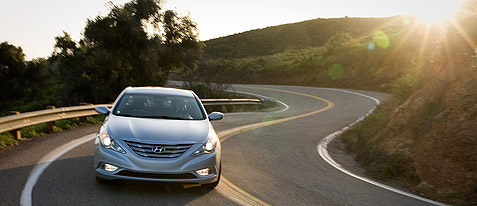
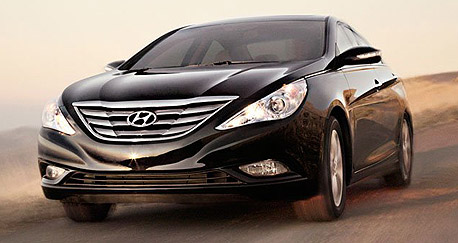
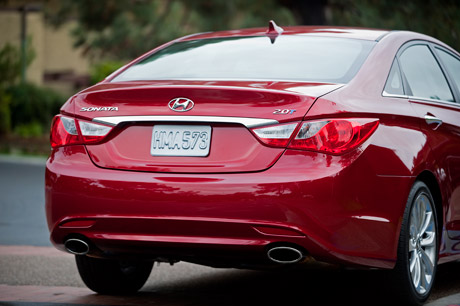
2011 Hyundai Sonata Limited 2.0T

Hyundai has been on a roll lately and the 2011 Hyundai Sonata Limited 2.0T will only grow Hyundai's presence in North America. Bullz-Eye recently tested the 2011 Hyundai Sonata Limited 2.0T and we were very impressed with all that this car has to offer at such a reasonable price.

Exterior

When I first took a look at the 2011 Hyundai Sonata Limited 2.0T, the sleek design stood out and made a grand first impression. Hyundai grew the offerings of the 2011 Sonata with the Limited 2.0 Turbo, adding 18-inch hyper silver alloy wheels and dual exhaust to the already very sharp exterior. Our pearl white test model also included side mirror mounted turn signal indicators, front fog lights and enough chrome trim to enhance the car's appearance. The smooth look of the 2011 Hyundai Sonata Limited 2.0 Turbo garnered plenty of compliments during my time behind the wheel and many confused the car for a more expensive luxury brand.

Interior

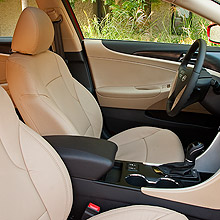
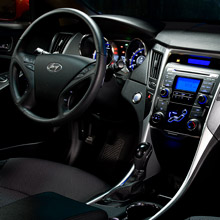
The interior of the 2011 Hyundai Sonata Limited 2.0 Turbo is loaded with options. The design is as far from conservative as one could imagine. I liked the wine leather interior seats, which worked well with the dark dashboard and carpet. The panorama moon roof was awesome and, with features like push button start, heated front and rear seats, leather wrapped steering wheel and shift knob, steering wheel mounted cruise, audio and phone controls I was looking forward to spending time in the 2011 Sonata. Also in our Limited package was an Infinity am/fm/XM audio with a popping subwoofer, HD radio with multicasting, iPod/USB and auxiliary input jacks. To round out the package, Hyundai included an integrated bluetooth hands free phone system, electrochromic auto dimming rearview mirror with compass, navigation with high resolution touchscreen display and rear back up camera. The 2011 Hyundai Sonata Limited 2.0 Turbo is loaded but that only gets you so far if the interior isn't a place that you want to spend time. Thankfully, the look and feel of the interior is again something you would expect from a much more expensive vehicle. At times I did see some sun reflection from the shiny plastic finishing in the interior but that was a minor negative in what is overall a very well thought out cabin.
Hyundai Sunata

Performance

The 2.0 Turbo Sonata is new for 2011 and you have to give the engineers at Hyundai credit for taking a chance on the beefed up 4-cylinder rather than offering a V6 like most competitors in this segment. According to Hyundai, the four-cylinder turbocharged gasoline direct-injection engine produces 274 horsepower and 269 lb-ft of torque across a broad rpm range (1.750 rpm to 4.500 rpm) and delivers 33 mpg highway and 22 mpg in the city. The all-new 2.0 Turbo four-cylinder engine incorporates a twin-scroll turbocharger that, when combined with the gasoline direct injection (GDI) technology, results in crisp, responsive power delivery. I found it to be a surprisingly powerful engine that was fun to drive – it surely lived up to the information released from Hyundai. Electronic stability control and a 6-speed auto transmission delivered a smooth riding experience with excellent handling. I worked the paddle shifters mounted on the steering wheel a bit and, although it was fun, I opted to stick with the auto ride for most of my time behind the wheel.

Overview

There was little doubt the Hyundai Sonata was going to be a hot seller and for good reason. The sleek looks combined with fuel efficiency, safety and quality placed the Sonata with the best in her class. This car is much more than the sum of its parts – everything has to come together in harmony to really make a winner. Our test model 2011 Hyundai Sonata Limited 2.0 Turbo had a final sticker price of $30,000, a price competitive enough to scare the Sonata's rivals. After a week driving the 2011 Hyundai Sonata Limited 2.0 Turbo, count me among the fans of this offering from Hyundai.
Click the thumbnails below to see full versions of each photo.
by .bullz-eye.com

Friday, May 6, 2011

Hyundai Sketches All-New i40 Sedan for Europe, will Debut in Barcelona


Just a couple of months after debuting the i40 Station Wagon at the Geneva Salon in March, Hyundai is now getting ready to lift the covers off the sedan version of its mid-size model, which will receive its world premiere at the upcoming 2011 Barcelona Motor Show on May 12th. The South Korean automaker released the first teaser rendering of the i40 Sedan, which will effectively replace the older generation of the Sonata in the European market and compete in the D-segment against the likes of the Opel Insignia, VW Passat, Toyota Avensis and Citroen C5. Read more »

Friday, April 22, 2011

2012 Hyundai Accent at the 2011 New York Auto Show


2012 Hyundai Accent 
2012 Hyundai Accent at the 2011 New York Auto Show
  • Competes with: Ford Fiesta, Chevrolet Sonic, Toyota Yaris, Honda Fit
  • Looks like: Email your office manager – the 40-mpg club needs to book a bigger conference room
  • Drivetrain: 138-hp, 1.6-liter four-cylinder with six-speed manual or automatic; front-wheel drive
  • Hits dealerships: Summer
Hyundai says its redesigned 40-mpg Accent — a car that debuted globally at the Beijing Auto Show a year ago — has the best-in-class standard fuel economy, a not-so-veiled jab at the segment’s other 40-mpg car, the Ford Fiesta, which requires an optional fuel-efficiency package to achieve that mileage number. Hyundai reckons the Accent will be EPA rated at an impressive 30 mpg city, too. With other competitors nearly here — from the Chevy Sonic to the Nissan Versa — we wonder how long Hyundai will be able to lay claim to the title. Available in sedan and four-door hatchback configurations, the Accent hits dealerships this summer.
More Coverage of the 2011 New York Auto Show
Hyundai’s “fluidic design” ethos gives the Accent a similar shape to the Elantra. Save the Elantra’s shapelier headlights — and, conversely, the Accent’s shapelier (optional) fog lights — it could be easy to mistake one for the other. Gone is the old Accent’s high-shelf dash; the new one’s wraparound textures appear more inviting, but we’ll have to see it in person to weigh in. Given the Accent’s segment, expect base models to come sparsely equipped; Hyundai says options will include iPod/USB ports, Bluetooth connectivity and a leather-wrapped steering wheel with audio controls.
The hatchback offers 21.2 cubic feet of volume behind the second row, which Hyundai says is best in class. Fold the seats down and its 47.5 cubic feet of maximum volume trails the voluminous Honda Fit by some 10 cubic feet, but it stacks up well against other small hatchbacks. What’s more, the Accent sedan offers 13.7 cubic feet of cargo volume. That’s not too shabby for an entry-level car.
Hyundai will pair the Accent’s new direct-injection 1.6-liter four-cylinder with a six-speed manual or automatic transmission. The engine makes a healthy 138 horsepower and 123 pounds-feet of torque, both substantial increases over last year’s port-injected 1.6-liter (110 hp and 106 pounds-feet). Both transmissions secure the 30/40 mpg rating — no options required — something actor Jeff Bridges will doubtless articulate in forthcoming Hyundai ads that he voices. A driver-selectable Eco button modifies drivetrain response to improve real-world mileage up to 7%, according to Hyundai.
Still, the Accent’s larger sibling, the Elantra, secures impressive EPA ratings of 29/40 mpg city/highway. We’re curious why the Accent only does 1 mpg city better, but we suspect weight plays a big role. The two sedans are only about 250 pounds apart — less than the average difference between a Ford Fiesta and Focus (318 pounds) or a Toyota Corolla and Yaris (421 pounds).
There won’t be any more $9,985 two-door hatchback, but Hyundai expects similar pricing with other outgoing trims despite the redesign offering a bevy of new engineering and safety technology. All-disc antilock brakes and a stability system will be standard, and given Hyundai’s recent string of Top Safety Picks from the Insurance Institute for Highway Safety, expect the new Accent to score considerably better than its poorly performing predecessor.
More photos below.
2012 Hyundai Accent
2012 Hyundai Accent
2012 Hyundai Accent
2012 Hyundai Accent
2012 Hyundai Accent
2012 Hyundai Accent
By Kelsey Mays

2012 Hyundai Accent a 40 MPG Value at $12,445

2012 Hyundai Accent
Just in case you had any inkling that the new 2012 Hyundai Accent could keep its sub-$10,000 starting price, you can give up those hopes now. The subcompact will start at $12,445, excluding $760 for destination, when it goes on sale later this summer. However, it will be the least expensive 40 mpg car on the market.
More Coverage of the 2011 New York Auto Show
The base price is for the sedan body style, which gets you the new, punchier 138-horsepower engine capable of 30/40 mpg city/highway, a six-speed manual transmission, power door locks and cabin air filter. Standard safety features include active headrests, electronic stability control and six airbags. A six-speed automatic is optional, and it’s paired with cruise control, an Eco mode to optimize fuel economy, air conditioning, six-speaker stereo and power windows and locks for an extra $2,750 ($15,195).
The new five-door hatchback body style starts at $14,595 and includes the same features as the base sedan, plus power mirrors and windows, air conditioning, six-speaker stereo with satellite radio and USB integration. An automatic transmission is a $1,200 option, and it gets you cruise control.
The Accent starts significantly higher than the just-announced Nissan Versa, a clear indication of two divergent approaches to the subcompact class. The Accent is shaping up to be a more premium product over the Versa.
Still, it’s not like the new Accent is expensive for the class: the Ford Fiesta ($13,320), Honda Fit ($15,100) and Toyota Yaris ($12,955) all have higher starting prices. It's also significantly less than the aging model it replaces. The 2012 hatchback starts $750 less than the new 2011 version, but now the base model doesn't include air conditioning standard, that comes as part of a $1,750 option package evaporating the savings for a majority of buyers.
Standard and Optional Features:
GLS Four-Door M/T
The Accent GLS M/T MSRP is priced at $12,445 and includes the following standard features:
  • 1.6-liter GDI DOHC I4 with Dual-CVVT 
  • Engine cover 
  • Hood insulator 
  • Trip computer 
  • Six-speed manual transmission 
  • Motor Driven Power Steering (MDPS) 
  • 14-inch steel wheels with full wheel covers 
  • 175/70R14 low rolling resistance tires and TPMS 
  • Front, side and head curtain airbags 
  • Vehicle Stability Management, ESC with TCS 
  • ABS, EBD, and brake assist with four-wheel disc brakes 
  • Front seatbelt pretensioner 
  • Active front head restraints 
  • Adjustable head restraints for all seating positions 
  • Tachometer 
  • Cabin air filter 
  • Power door locks 
  • Audio prep package with four speakers 
  • Tilt steering wheel 
  • Driver seat armrest 
  • Front door map pockets 
  • Front passenger seatback pocket 
  • 60/40 split folding rear seatback 
  • Dual vanity mirrors 
  • Map, dome and cargo lights 
  • Six-way adjustable driver seat including height adjustment 
  • Front two-speed intermittent wiper 
  • Tinted glass with windshield shade band 
  • Rear defroster with timer 
  • Roof-mounted antenna 
GLS M/T Options: Comfort Package ($1,750 MSRP):
  • Air conditioning • AM/FM/XM® Satellite Radio/CD/MP3 audio system with tweeters, iPod®/USB auxiliary input jacks 
  • Power windows & mirrors 
  • Cloth door inserts 
GLS A/T The Accent GLS A/T MSRP is priced at $15,195 and includes the following GLS M/T features plus:
  • Six-speed automatic transmission with SHIFTRONIC® 
  • Active Eco System 
  • Air conditioning 
  • Cloth door inserts 
  • AM/FM/XM® Satellite Radio/CD/MP3 audio system with tweeters, iPod®/USB auxiliary input jacks 
  • Power windows & mirrors 
GLS A/T Options: Premium Package ($1,300 MSRP):
  • Remote keyless entry with panic 
  • Steering-wheel-mounted audio controls 
  • Cruise control 
  • Bluetooth® hands-free phone system with voice recognition 
  • Premium cloth seats 
  • Chrome inside door handles 
  • Piano black accents 
  • Sunglasses holder 
  • Sliding armrest storage box 
  • Fog lights 
  • 16-inch alloy wheels with 195/50R16 tires 
  • Bodycolor door handles 
GS Five-Door The Accent GS M/T is priced at $14,595 and includes the following standard features:
  • 1.6-liter GDI DOHC I4 with Dual-CVVT 
  • Engine cover  
  • Hood insulator 
  • Trip computer 
  • Six-speed manual transmission 
  • Motor Driven Power Steering (MDPS) 
  • 14-inch steel wheels with full wheel covers 
  • 175/70R14 low rolling resistance tires & TPMS 
  • Front, side and head curtain airbags 
  • Vehicle Stability Management, ESC with TCS 
  • ABS, EBD, and brake assist with four-wheel disc brakes 
  • Front seatbelt pretensioner 
  • Active front head restraints 
  • Adjustable head restraints for all seating positions 
  • Tachometer 
  • Air conditioning 
  • AM/FM/XM® Satellite Radio/CD/MP3 audio system with six speakers, and iPod®/USB auxiliary input jacks 
  • Driver seat armrest 
  • Power windows, mirrors and door locks with remote keyless entry with panic 
  • Cloth door insert 
  • Tilt steering wheel 
  • Front door map pockets 
  • Front passenger seatback pocket 
  • 60/40 split folding rear seatback 
  • Dual vanity mirrors 
  • Map, dome and cargo lights 
  • Six-way adjustable driver seat including height adjustment 
  • Front two-speed intermittent wiper 
  • Tinted glass with windshield shade band 
  • Sunglasses holder 
  • Bodycolor mirrors and door handles  
  • Rear defroster with timer 
  • Roof-mounted antenna 
  • Rear wiper 
GS Options: Automatic transmission ($1,200 MSRP) includes:
  • Six-speed automatic transmission with SHIFTRONIC®, and Active Eco System 
  • Cruise control 
SE Five-Door The Accent SE M/T MSRP is priced at $15,795 and includes all the GS equipment plus the following:
  • Sport-tuned steering 
  • Cruise control 
  • Steering-wheel-mounted audio controls 
  • Bluetooth® hands-free phone system with voice recognition 
  • Leather-wrapped steering wheel and shift knob 
  • Premium cloth seats 
  • Chrome inside door handle 
  • Piano black accents 
  • Sliding armrest storage box 
  • 16-inch alloy wheels with 195/50R16 tires 
  • Fog lights 
  • Rear spoiler
By Colin Bird

Thursday, April 21, 2011

2012 Hyundai Accent: Up Close View picture and news

2012 Hyundai Accent: Up Close View picture and news
2012 Hyundai Accent
Thêm chú thích
It comes with some embarrassment that I mistook the white Elantra on stage at Hyundai’s press conference for the Accent. (And here’s the admittance, in virtual ink, to live on forever.) I had to examine the facial differences to tell the two apart: The Accent’s headlights are more clipped, while the fog lights curl back. It’s vice versa on the Elantra.
More 2011 New York Auto Show Coverage
The fact is, Hyundai’s fluidic design is taking hold, and the automaker’s cars look more similar than arguably at any point in its U.S. history. That’s not necessarily a bad thing; BMW and Audi have cultivated similar faces across their lineups for years.
2012 Hyundai Accent
Cabin materials in the Accent feel segment-competitive. The dimpled plastics at eye level are a welcome distraction from their modest quality, and the controls look sharp. Hyundai’s two Accents on display – a sedan and hatchback, both well-optioned – had chrome door handles and piano-black trim, which are uncommon niceties for the class. Anyone with big hands may find the steering-wheel buttons too small, and it won’t take long for your elbows to wish the door armrests had more (any, really) padding.
2012 Hyundai Accent
The Accent offers no telescoping steering wheel, something the Honda Fit and Ford Fiesta do. But I found the wheel close enough to me, and I usually deem non-telescoping wheels too far away. (Short drivers, on the other hand, may wish it sat farther forward.) For a small car, the driver’s seat extends impressively far rearward. Even with the height jacked up, I sat comfortably with an inch of rearward travel to spare. Storage areas abound: The center console could stash a couple of bulky sunglass cases, and Hyundai claims the glove box beats that of the Fit, Chevy Aveo and Toyota Yaris. It’s roomy, at any rate.
2012 Hyundai Accent
Legroom in back is modest, and typical of this class, the rear seat sits too low to the floor. Headroom in the hatchback is good, however. In the sedan it’s tight. The rear window in both the hatchback and sedan is small, which hurts the view straight back, but neither car has massive C-pillars.
2012 Hyundai Accent
By Kelsey Mays

Wednesday, April 20, 2011

Hyundai Tiburon Replacement First Headed to U.K. in 2011


The long-rumored successor to the Hyundai Tiburon will be stopping in the United Kingdom before coming to the States.

The compact Hyundai two-door, known as the Coupe in the U.K., is slated to go on sale in Britannia in early 2011 according to U.K. outlet Autocar. The British rag recently spotted the compact four-seater in the flesh on a trip to South Korea and noted the small Hyundai looks exceptionally similar to the oft-mentioned Veloster concept. The upcoming 2+2 Coupe will be equipped with Hyundai's direct-injected 1.6-liter inline-four developing around 140 horsepower.


If the Coupe makes it to the United States under the resurrected Tiburon nameplate, it will provide a more affordable (and front-wheel drive) alternative to the Genesis Coupe. Expected to arrive in Fall 2011 for the U.S., Hyundai hopes to achieve 40 mpg without a hybrid powertrain and take on the Honda CR-Z. A high-performance model may also be in the works.

The new Hyundai coupe will make its European debut at the Paris motor show this October.

Source: Autocar,automobilemag

Rhys Millen Scores First Podium Finish for Hyundai Genesis Coupe review and news

 review and news
The main attraction at last weekend's Formula Drift event in Long Beach was the final bout between Ford driver Vaughn Gittin Jr. and Hyundai pilot Rhys Millen.

Gitten Jr. got the upper hand this round in his 2010 Falken Tire Ford Mustang GT, but with the collection of considerable talent in the series, the Maryland native will have to work hard to defend his crown.


The knockout series witnessed the competition whittle down to Gittin Jr., Millen, Tanner Foust, and Fredric Aasbo in the semi-finals. Foust, two-time Formula D champion, took third position in his 800-horsepower, NASCAR-powered Scion tC. Millen had a terrific showing for Hyundai, putting his 650-horsepower Genesis Coupe in second place and erasing any competitive doubts stemming from the 2009 season.

“I was in sync with my Genesis Coupe during the entire campaign and step one was to qualify first,” said Millen. “The car had so much grip and power I was able to put it close to the walls and mirror the other competitors’ cars’ every move. Nothing compares to the pressure and thrill of the ‘win it or lose it’ factor while competing against more than 50 other cars and drivers.”

The next round of the 2010 Formula Drift season will be held at Road Atlanta May 7-8.

Sources: Formula Drift, Hyundai

Unlimited Potential: First Look at Rhys Millen’s New Hyundai Pikes Peak Car

When it comes to the “unlimited” class at the Pikes Peak International Hill Climb, the sky is literally the limit. Drivers have been fielding some wild vehicles in the group for decades on end, but none has been quite as intimidating as Rhys Millen’s latest ride, the Hyundai Genesis RMR PM850.


“This is the package I need to break the record,” Millen said. “We are building a car for today’s [course]. The car will have a sleek aerodynamic body, the grip of Toyo Proxy tires, and the power and durability of a Hyundai engine.”

That engine, along with the Hyundai emblems, may be the only thing remotely associated with a production Genesis Coupe. The PM850 looks as if it’d be more at home on the Hunaudières Straight than a Hyundai showroom floor. Closely resembling a contemporary Le Mans prototype, the PM850 makes use of a chromoly frame and roll cage, along with a body crafted entirely of carbon fiber.

Although Rhys Millen Racing started with a stock 3.8-liter “Lambda” V-6, the finished product is radically different than the six-cylinder found in the Genesis Coupe. RMR stroked the engine, bringing its displacement up to 4.1 liters, and then mated the six-cylinder with a HKS T04Z turbocharger, an intercooler, and customized exhaust manifolds. At this point, the team says the engine is capable of producing nearly 750 horsepower.

Harnessing that power may prove to be difficult, but RMR thinks a custom all-wheel-drive system may do the trick. The turbocharged Lambda is mated to a semi-automatic transmission supplied by Weismann, which then channels power through an active center differential to two Quaife differentials. According to Hyundai, the active center diff will allows Millen to send anywhere from 10 to 100 percent of all torque to the front wheels -- important for configuring the car for both the asphalt and dirt portions of the run.

The important question, however, is if the PM850 will be enough to knock Nobuhiro “Monster” Tajima from his record, which stands at 10 minutes and 1.408 seconds. The quest is nothing short of a family affair, as Rhys’ father, Rod, set the previous Pikes Peak record in 1994, racing to the top of the mountain in 10 minutes and 4.06 seconds.

“Breaking into the 9s has been a desire of mine for the last 10 years,” Millen said last week. “I finally have the team, support, and infrastructure to put in a serious effort to go after the world record.

“The main focus is to be the fastest car up the hill, slay the monster, and get the record back in the family name -- the Millen name.”

Source: Hyundai/ RMR

2011 NYIAS: Hyundai Pulls the Wraps off U.S. Market 2012 Accent


With fuel prices on the rise again, efficient sub-compact models like the Accent are coming back to the spotlight. At the 2011 New York Auto Show, the South Korean automaker pulled the wraps off its latest iteration of the Accent in U.S.-spec. Slated to hit dealerships this summer, the 2012 Accent is offered in both five-door hatchback and four-door saloon body styles and promises to deliver a best-in class fuel economy of 30mpg city and 40 mpg highway.

Read more »

Tuesday, April 19, 2011

Shanghai Auto Show: Hyundai Elantra Puts on a New Face for China


The Hyundai Group is now pointing its arrows to the world’s biggest auto market with the unveiling of two new models for China at this week’s 2011 Shanghai Auto Show, the Elantra Yuedong compact sedan and the mid-size Azera, which is badged as Grandeur in some markets.

If the Elantra Yuedong looks familiar, that’s because it is a facelifted version of the fourth generation model sold in the States until 2010. The most prominent change on the outside concerns the revised front that draws on the Azera’s styling.

According to Hyundai, the interior has also been upgraded with higher quality materials and new convenience and safety features such as a smart key / button start, front side airbag, Motor Driven Power Steering (MDPS), Navigation, USB2.0 port and eco-driving guide system.

Read more »

Evolution of Car Logos review and news icon


Evolution of Car Logos review and news icon
 review and news  icon
his article should come in handy for the next time you’re stuck in traffic: have you ever wondered why the Audi in front of you has a logo of four interlocked rings? Did you know that the Cadillac emblem was inspired by a family crest of a nobleman who later turned out to be a fraud? Or that Volkswagen was Hitler’s idea?
We took a look at the evolution of tech logos before. Today, let’s take a look at the fascinating stories behind the logos of some of the most popular cars in the world:

Alfa Romeo


Source: Cartype
Surprise! Alfa Romeo, the car manufacturer and pride of Italy, traced its beginnings to France. In 1910, Milan aristocrat Cavaliere Ugo Stella collaborated with the French car company Darracq to market the line in Italy. When the partnership failed, Stella moved the company and renamed it Anonima Lombarda Fabbrica Automobili (Lombard Automobile Factory, Public Company) or A.L.F.A.
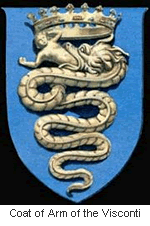
Alfa Romeo’s distinctive logo was created in 1910 by a draftsman named Romano Cattaneo. One day, while waiting for a tram at the Piazza Castello station in Milan, he was inspired by the red cross in the Milan Flag and the Coat of Arms of the noble House of Visconti, which featured a biscione (grass snake) with a man in its jaws, symbolizing "Visconti’s enemies that the snake [was] always ready to destroy." (Source) Two Savoia dynasty knots separated the words ALFA and MILANO.
The Romeo part came in 1916 when Neapolitan businessman Nicola Romeo bought the company and converted its factories to produce munitions and machineries for World War I. After the war, the company went back to producing cars and took on its owner’s last name to become Alfa Romeo.

Aston Martin
Evolution of Car Logos review and news icon
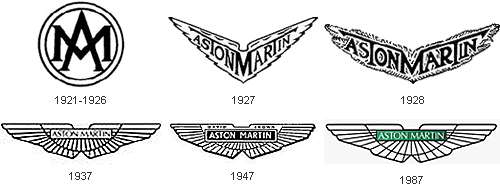
In 1913, Lionel Martin and Robert Bamford founded a company that later would become Aston Martin. At the time, Martin & Bamford Limited produced Singers racing cars, but the duo wanted to create a more sophisticated model of their own. They named their first car Aston Martin after the founder Lionel Martin and the Aston Clinton hill climb racing course where their Singers car had won previously.
We can’t talk about Aston Martin without mentioning James Bond. In 1959, Ian Fleming put his super spy James Bond in an Aston Martin DB Mark III. When it was made into a movie in 1964, Bond drove an updated, supersleek silver Aston Martin DB5 (complete with machine gun, passenger ejector seat, and revolving number plates!)
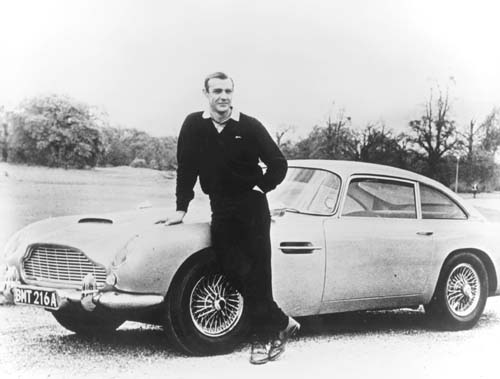
James Bond and his Aston Martin DB5 in Goldfinger
Interestingly, Ian Fleming himself didn’t drive Aston Martin. He preferred the 1963 Studebaker Avanti!

Audi
Evolution of Car Logos review and news icon
German engineer August Horch, who used to work for Karl Benz, founded his own automobile company A. Horch & Cie in 1899. A decade later, he was forced out of his own company and set up a new company in another town and continued using the Horch brand. His former partners sued him, and August Horch was forced to look for a new name.
When Horch was talking to his business partner Franz Fikentscher at Franz’s apartment, Franz’s son came up with the name Audi:
During this meeting Franz’s son was quietly studying Latin in a corner of the room. Several times he looked like he was on the verge of saying something but would just swallow his words and continue working, until he finally blurted out, "Father – audiatur et altera pars… wouldn’t it be a good idea to call it audi instead of horch?". "Horch!" in German means "Hark!" or "listen", which is "Audi" in Latin. The idea was enthusiastically accepted by everyone attending the meeting. (Source: Wikipedia, A History of Progress (1996) – Chronicle of the Audi AG)
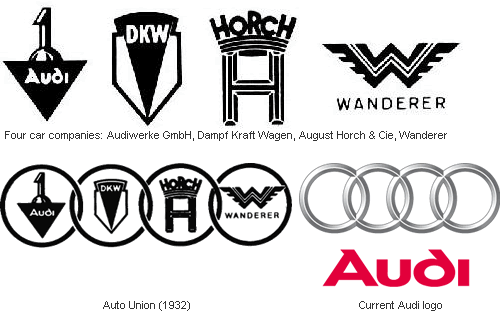
And so Audiwerke GmbH was born in 1910. In 1932, four car makers Audi, Horch, DKW, and Wanderer merged to form Auto Union. The logo of Auto Union, four interlinked rings that would later become the modern Audi logo, was used only in racing cars – the four factories continued to produce cars under their own names and emblems.
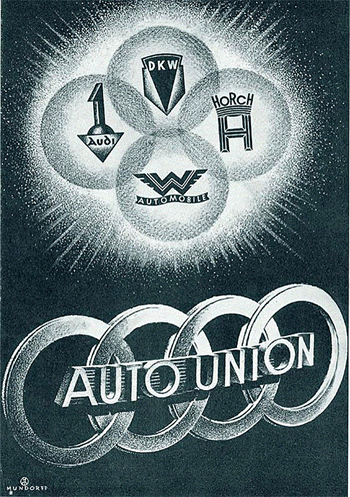
Four car companies became Auto Union (1932)
Fast forward to 1985 (skipping a whole lot of history), when Auto Union ultimately became the Audi we know today.

BMW


Source: Motorcycle
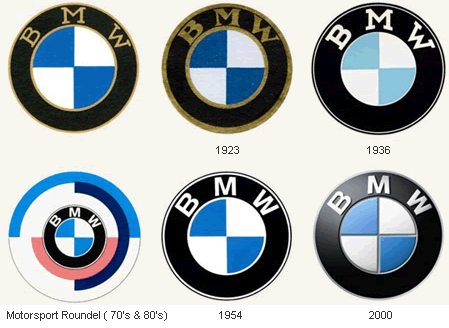
In 1913, Karl Friedrich Rapp and Gustav Otto founded two separate aircraft factories that would later merge to form BMW or Bayerische Motoren Werke AG (Bavarian Motor Works). Rapp and Otto actually had little to do with BMW’s manufacturing of cars. Josef Popp, Max Friz and Camillo Castiglioni were the ones who played big roles in making BMW a modern car manufacturer.
Source: Cartype
The circular BMW logo was a representation of a spinning propeller of a Bavarian Luftwaffe. At the time, aircrafts were painted with regional colors and the colors of the Bavarian flag were white and blue. It is said that the pilot saw the propeller as alternating segments of white and blue, hence the logo. The roundel was a nod to Karl Rapp’s original company.
During World War I, BMW was a major supplier of airplane engines
(and later airplanes such as the Red Baron)
(thanks Redditors!) to the German government. After the war, Germany was forbidden by the Treaty of Versailles to manufacture airplanes and BMW was forced to change its business: it first made railway brakes before making motorized bicycle, motorcycles and cars.
Update 3/6/08: Neatorama readers Dan S. and Bruce Kennedy who pointed out that the idea of BMW logo being derived from spinning propeller was actually an advertisement by the company (scroll down about halfway). Also thanks to klaus who pointed us out to the logo of EMW, which BMW took over in 1928.

Buick


Early Buick emblems (source: Buick Car Club of Australia)
The Buick Motor Company was founded in 1903 by David Dunbar Buick, a Scottish-American inventor who invented the overhead valve engine. If you didn’t recognize the name, you’re not alone – but remember this: Buick, a high school drop out founded a company that later became the world’s largest auto company, General Motors.
At 15 years of age, Buick dropped out of school to work for a plumbing fixture manufacturer. When that business failed, Buick and his friend took it over – but within a few years, Buick had an argument with his partner because he preferred to spend his time tinkering with car engines. Buick sold his share in the company and quit.
With the money, Buick founded the Buick Motor Company and within a few years ran it to the ground. He was kicked out of the company by his partner William "Billy" Durant in 1906 and later sold his stock for a mere $100,000. Had he held on to his shares, it would’ve been worth well over $100 million today. In his later years, Buick held low-paying jobs and couldn’t even afford a telephone. He died penniless as an inspector at the Detroit School of Trades. Ironically, years later Durant himself would be forced out. General Motors, the company that Durant built, refused him pension and he died almost penniless. (Source)

Buick crests and tri-shields (source: Buick Car Club of Australia)
Back to the logo story: Early Buick logos were variations of the cursive word "Buick." In 1930s, General Motor Styling researcher Ralph Pew found a description of the Scottish "Buik" [sic] family crest and decided to use it as a radiator grille decoration. In 1960, the logo incorporated three such shields, to represent the three Buick models then built: LeSabre, Invicta, and Electra.
In 1975, Buick changed their logo to a hawk named "Happy" with the launch of their Skyhawk line. However, in the late 1980s, as the Skyhawk car was retired, Buick went back to the tri-shield logo.

Cadillac


Source: car-nection.com, who has lots more Cadillac emblems.
When Henry Ford left his second automobile company, Henry Ford Company (see below), his financial backers tried to liquidate the company’s assets. An engineer named Henry M. Leland persuaded them to continue the company instead. They listened, and so Cadillac was born.
Cadillac’s first logo was based on a family crest of a minor aristocrat that the company was named after: Antoine de La Mothe, Seigneur de Cadillac (Sir of Cadillac). In 1701, de La Mothe founded Fort Pontchartrain which would later become Detroit. Cadillac was named after de La Mothe in 1902, following a bicentenary celebration of the founding of the city.
Problem was, de La Mothe was never a nobility! Born Antoine Laumet, de La Mothe was forced to leave France for America under a mysterious circumstance (some say he committed a crime or was unable to pay his debt). In the New World, he was able to assume a new identity and cobbled together a famiy crest with elements "borrowed" from, shall we say nobler sources.
In 1998, Cadillac had a new design philosophy called "art and science" and had its logo redesigned. Gone were the six birds called the merlettes, the crown, and the entire fabricated de La Mothe family crest as the company tried to shake up its stodgy image. The new logo made its debut a few years later, looking positively like it was made by Piet Mondrian!

Fiat


Source: Fiat
Fiat, then named Fabbrica Italiana Automobili Torino (Italian Automobile Factory of Turin), was founded in 1899 by a group of investors, including Giovanni Agnelli who later became its Managing Director. Agnelli bought his shares for $400 (about $10,000 in 2007 money). It’s worth billions now, and there had been an Agnelli in Fiat management ever since. Regardless or perhaps because of its wealth, the Agnelli clan remained a fractious and complicated group of people.
Supposedly, the famous Fiat "scrabble tiles" logo of the 1960s was designed by the company’s Chief Designer who was driving past the Fiat factory during a power outage and saw an outline of the factory’s neon sign against the dark sky (Source: The Language of Auto Emblems)

Ford

Most people know that Ford was founded by (who else?) Henry Ford. What most people didn’t know was that this was his third automobile company. Ford experimented with cars while working for Thomas Edison, and left to found his first auto company, The Detroit Automobile Company, which went bankrupt in just 2 years. He then built a race car and founded Henry Ford Company. Ford left that one after just one year (the company later became Cadillac – see above).
In 1902, Ford went on to create his third automobile company, the Ford & Malcomson, Ltd., and almost lost that one when sales were slow. He was unable to pay his bills to John and Horace Dodge, who supplied parts. Ford’s partner brought in a group of investors and even convinced the Dodge Brothers to accept shares in the company, which was renamed Ford Motor Company. Later, the Dodge Brothers went on to form their own car company (can you guess what?)
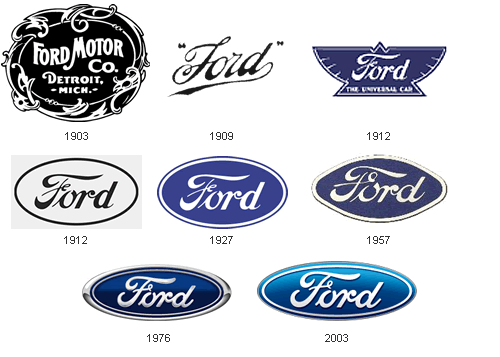
In 1909, Childe Harold Wills, Ford’s first chief engineer and designer (who also help to design the Model T), lend a script font that he created to make his own business card, to create the Ford logo. The famous blue oval was added later for the 1927 Model A – it remained in use until today.

Mazda


Source: Mazda [wikipedia] and Mazda Brand Evolution
Mazda began its life in 1920 as the Toyo Cork Kogyo Co. in Hiroshima, Japan. At the time, there was a cork shortage because of World War I, so the company was founded to process a cork substitute made from the bark of an Abemaki or Chinese cork oak tree. It was a good idea at the time, but shortly afterwards Japan could get real cork again and the company foundered.
In 1927, Jujiro Matsuda came onboard and the company began manufacturing tools, three-wheeled "trucks" and then cars. After World War II, the company formally adopted the name Mazda, which depending on who you ask, stood for the Zoroastrian god Ahura Mazda or an anglicized pronunciation of Matsuda the founder’s name (or both).
In the 1936 logo, the M shaped curve was inspired by the emblem of Hiroshima city. The 1991 and 1992 logos symbolized a wing, the Sun and a circle of light. Mazda’s current logo, nicknamed the "owl" logo, was designed by Rei Yoshimara in 1997. The stylized "M" was meant to look like stretched wings, but many people saw a stylized tulip instead.

Mercedes-Benz

The modern Mercedes-Benz traced its lineage to a 1926 merger of two car companies, Daimler-Motored-Gesellschaft or DMG, founded by Gottlieb Daimler (along with Wilhelm Maybach), and Benz & Cie, founded by Karl Benz. Both Daimler and Benz worked independently to invent internal combustion-powered automobiles. Their factories were actually just 60 miles apart, yet they didn’t know of each other’s early work.
After World War I, the German economy was in tatters, and to survive, the two companies formed a syndicate in 1924, where they would continue to sell their separate brands but would standardize design, share purchasing and advertising. In 1926, however, the two companies merged into Daimler-Benz.

The name "Mercedes" came about in 1900. A wealthy European businessman and racing enthusiast named Emil Jellinek began selling Daimler’s cars. He wanted a faster car, and specified a new engine to be designed by Maybach and to be named after his 10-year-old daughter’s nickname, Mercédès or Spanish for
"grace."
"Mercy" (See below)
Jellinek was quite a character. He used to pepper DMG’s engineers with colorful suggestions and criticism such as "Your manure wagon has just broken down on schedule" and "You are all donkeys". However, as he actually sold a lot of cars, he was tolerated and even listened to. Later, Jellinek would add Mercedes to his own and became Emil Jellinek-Mercedes. (Source: My Father Mr. Mercedes by Guy Jellinek-Mercedes and MBUSA Biographies)
The star in Daimler’s logo came from an old postcard where Gottlieb Daimler had drawn a star above the picture of his house and wrote that "this star would one day shine over [his] own factory to symbolize prosperity." The three-pointed star symbolized Daimler’s ambition of making vehicles "on land, on water and in the air." (Source: Daimler)
After the merger, a new logo was designed. It combined the symbols of the two companies: the three-pointed star of DMG and the laurel wreath of Benz.
Update 2/18/08: There’s a dispute on the origin of the name “Mercedes.” According to Baby Names World, Mercedes is a girl’s name of Spanish origin meaning “Mercy.” It was taken from the Virgin Mary’s liturgical title “Maria de las Mercedes” (Mary of the Mercies; ‘Our Lady of Ransom’):

Latin ‘mercedes’ originally meant ‘wages’ or ‘ransom’.
In Christian theology, Christ’s sacrifice is regarded as a ‘ransom for the sins of mankind’, hence an ‘act of ransom’ was seen as identical with an ‘act of mercy’.

Mitsubishi

Source: Mitsubishi
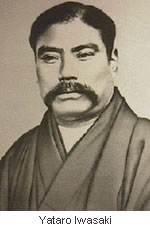
In 1854 feudal Japan, a man named Yataro Iwasaki, son of a provincial farmer whose grandfather sold the family’s samurai status to settle some debt, began his career on the wrong foot: he was called home from school at the age of 19 when his father was injured in a dispute with the village leader. Iwasaki asked a local magistrate to hear his case, and when refused, accused the man of corruption. Iwasaki was promptly jailed for seven months.
Fast forward to 1868: Iwasaki was working for the Tosa clan when the Meiji Restoration abolished Japan’s feudal clan system. He acquired Tsukumo Shokai, the Tosa clan’s shipping business and renamed it Mitsubishi in 1873.
It was a fourth-generation Iwasaki, a man named Kayota Iwasaki, who turned Mitsubishi into a giant corporate group that included an automobile manufacturing company, Mitsubishi Motors.
The name Mitsubishi was a combination of the words "mitsu" (three) and "hishi" (water chestnut, used in Japan to mean a rhombus or a diamond shape). The official translation of the name was "three diamonds."
The Mitsubishi logo was a combination of the Iwasaki family crest, three stacked diamonds, and the three-leaf crest of the Tosa Clan.

Peugeot

Peugeot got its start in 1812 in Montbeliard, France, when two brothers, Jean-Pierre and Jean-Frédéric Peugeot converted their windmill into a steel mill. Their first products were rolled steel for saw blades and clock springs, as well as cylindrical steel rods. For decades, the Peugeot family business made metal goods, machine tools, crinoline dresses, umbrellas, wire wheels, irons, sewing machines, kitchen gadgets and by 1885, bicycles.
Indeed, Peugeot’s entry into the automobile business was by way of bicycles. At the time, the company was one of the largest bicycle manufacturers in France. In 1889, Armand Peugeot created the company’s first steam-powered car. A year later, he abandoned steam in favor of gas-powered internal combustion engine after meeting Gottlieb Daimler.
The Peugeot "lion" logo was designed by jeweler and engraver Justin Blazer in 1847. It was based on the flag of the Région Franche-Comté. The logo was stamped on Peugeot kitchen gadgets to denote the quality of their steel. It took Armand 14 years to convince his family that cars could be a moneymaker. Only then did they allow him to use the Peugeot lion logo. (Source: Independent)
Now, you may not drive a Peugeot car, but I bet you’ve used a Peugeot invention of 1842: the peppermill. The mill’smechanism was so reliable that it remained virtually unchanged until today.

Renault


Source: Renault
Louis Renault was 21 when he made his first car in the backyard of his parent’s home. He soon got orders for cars, so in 1898, along with his brothers and friends, Louis opened the company Société Renault Frères in Boulogne-Billancourt, France.
The first Renault logo, drawn in 1900 featured the three initials of the Renault brothers: Louis, Ferdinand and Marcel. In 1906, the logo changed to a front end of a car enclosed in a gear wheel.
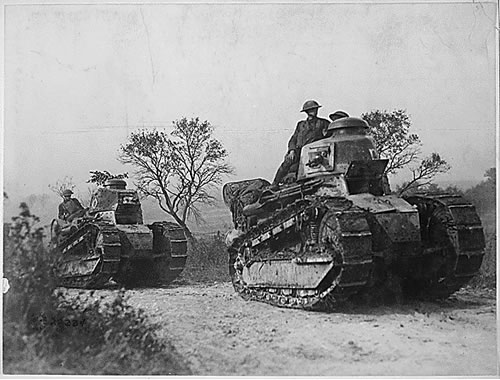
Renault FT-17 tank, driven by American troops, going forward to the battle line in the Forest of Argonne. (Source: The National Archives)
During World War I, Renault manufactured light tanks for the Allies called the Renault FT-17. This was so popular that after the war, Renault actually changed its logo into a tank. The diamond shape was introduced in 1925 and remained until today. The modern Renault logo was created in 1972 by Victor Vasarely [offical website | wikipedia], the father of Op art (or optical art).

Saab

If you’ve ever seen a Saab car commercial, then you’d know that the company was "born from jets". You wouldn’t know it from the car’s staid style, but historically this was accurate: In 1937, an aircraft company called Svenska Aeroplan Aktiebolaget ("Swedish Aeroplane Limited" or simply SAAB) was created to meet the needs of the Swedish Air Force.
When World War II ended, SAAB the airplane company started making cars to diversify its business. The first car it made was a prototype called the the Saab 92001 or ursaab (meaning "original Saab") in 1946. It was test-driven for nearly 330,000 miles (530,000 km) in utter secrecy, usually on narrow and muddy forest roads in the early mornings or late nights.
In 1947, the Saab Automobile company was incorporated. The company’s first car was the Saab 92, named because it was simply the company’s 92nd design project (the previous 91 had all been aircraft).
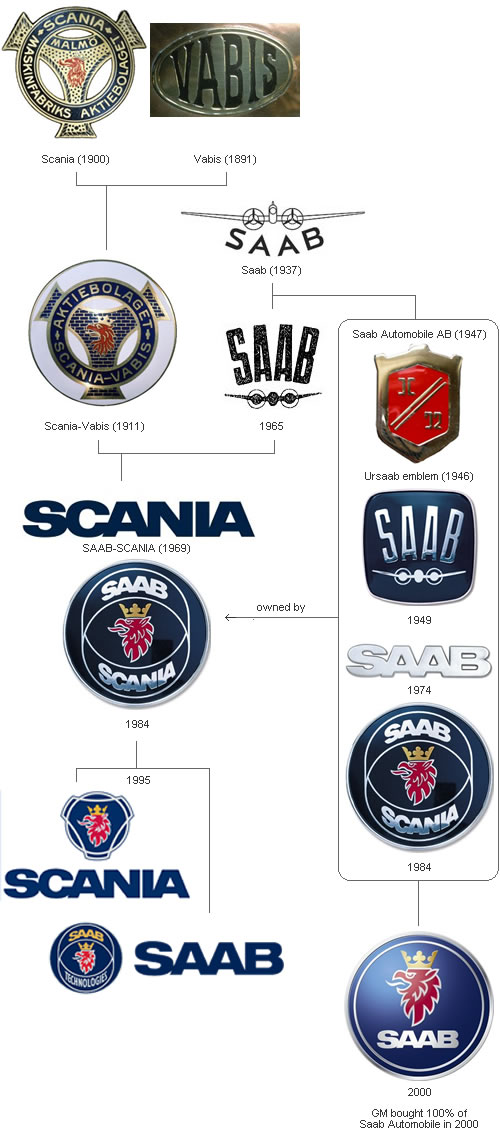
The griffen logo, featuring the head of a mythological beast that had a body of a lion and head and wings of an eagle, came from Vadis-Scania, a truck manufacturer that merged with SAAB (airplane) company. The griffen was a coat of arms of the province Scania.
In 2000, Saab Automobile company was bought out by General Motors, and thus no longer had any connection with SAAB outside of its history and logo similarities.
Confused? Don’t worry about it, just enjoy the pictures.

Volkswagen


Source: TheSamba
You wouldn’t know it from the company’s website but Volkswagen (German for "People’s Car") can trace its history straight to the villain of World War II: Adolf Hitler.
Here’s the short version of the story: After World War I, Germany’s economy was shot and cars cost more than most people can afford. When Hitler rose to power and became Chancellor, he spoke at the 1933 Berlin Auto Show of his idea to create a new and affordable car.
At the same time, Ferdinand Porsche (yes, that Porsche) was designing an odd-looking yet inexpensive car (which would later become the Volkswagen Beetle). Porsche met with Hitler in 1934, who asked that the car to have the following specifications: it should have a top speed of 100 km/h (62 mph), a fuel consumption of 42 mpg, and could carry 2 adults and 3 children. He said the car should look like a Maikaefer – a May beetle and even gave Porsche a sketch of the basic design. Porsche promised to deliver the design, with prototype cars to be built by Daimler-Benz.
In 1937, the Gesellschaft zur Vorbereitung des Deutschen Volkswagens mbH was created (it became simply Volkswagenwerk GmbH a year later). In 1938, Hitler opened the state-funded Volkswagen factory in Wolfsburg, which was to produce the KdF-wagen (kraft durch freude, meaning "strength through joy"). Few were actually built, instead, the factory (employing forced labor) churned out military car, based on the same chassis: the Kübelwagen, Schwimmwagen, and Kommandeurwagen.
It was later found out that Hitler had this in mind all along. He added an extra secret specification to Porsche’s design: the car was to be able to carry 3 men, a machine gun, and ammunition.
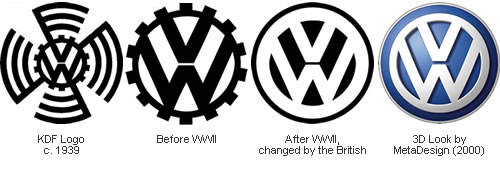
After Germany was defeated in World War II, the British took over the Volkswagen factory and the KdF-Wagen was renamed the Beetle. The British then sought to give control of the company – first they asked the Ford Motor Company, then the French Government, other British car manufacturers and lastly, Fiat. All turned down this "free offer" because they thought the Beetle’s design was inferior and that the company would be a money drain. (Source: The Auto Channel)
So, the British gave the Volkswagen company back to the German government in a trust. Later, having sold more than 21 million cars, the Volkswagen Beetle would become one of the world’s best selling cars ever.
The VW logo itself was supposedly designed by Franz Xavier Reimspiess, an employee of Porsche, during an office logo design competition. He was given a one time payment of 100 Reichsmarks (about $400).

If you didn’t see your favorite car’s logo history, chances are it is because its logo didn’t change much over the years. There are also dozens of large car companies in the world (many more if you counted the defunct ones), and we couldn’t fit every single one in this article. If I missed anything, please let me know in the comment.
by neatorama.com